
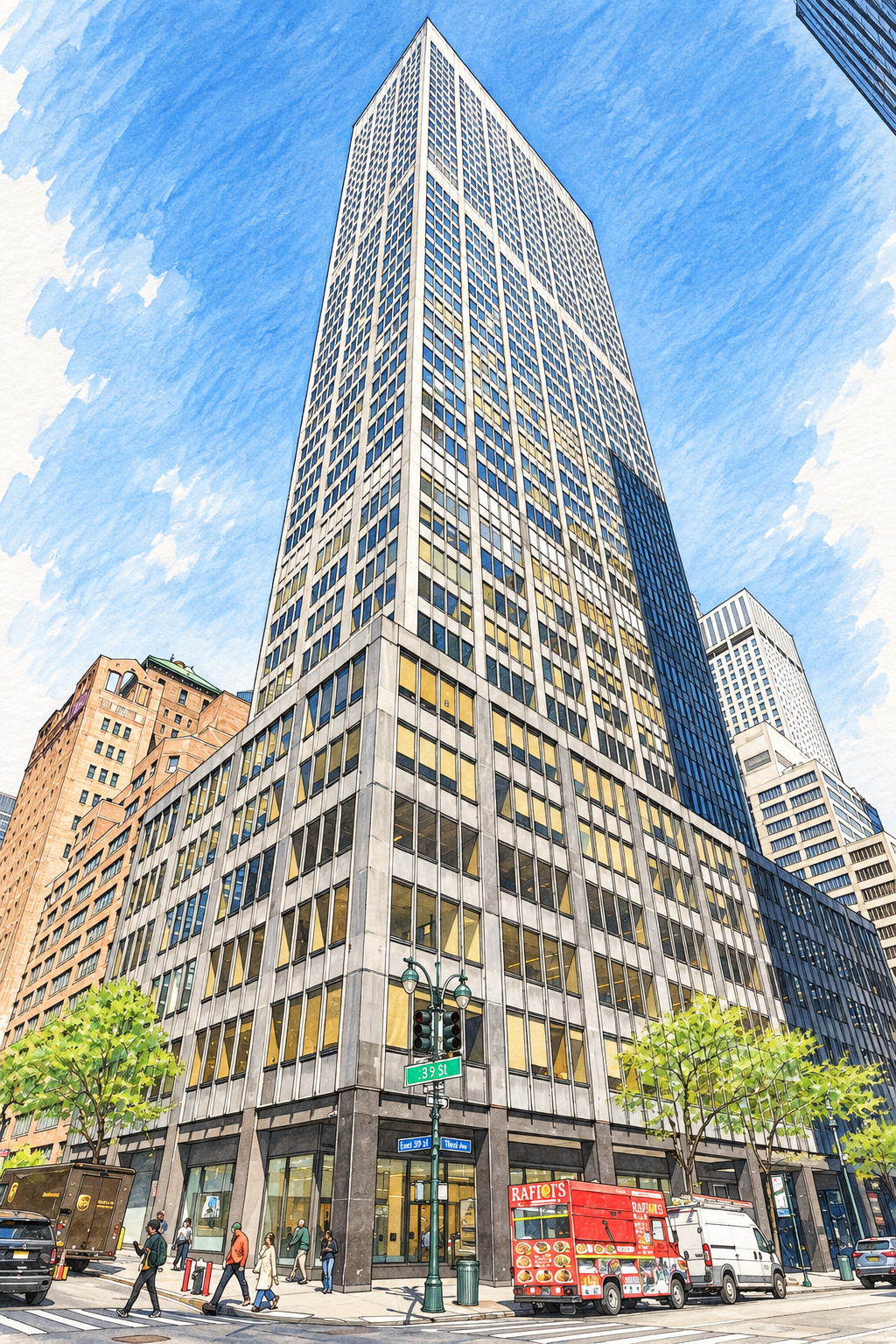
A Major Office Transaction Signals Renewed Confidence
For several years, Manhattan’s office market has faced questions about its long-term future.
Remote work, rising interest rates, changing corporate space requirements, and declining property valuations created uncertainty throughout the commercial real estate industry.
Some investors reduced their exposure to office properties, while others waited for prices to stabilize.
However, a major transaction in Midtown East suggests that experienced investors continue to see opportunities in well-located Manhattan office buildings.
In September 2026, L&L Infinite and its investment partners completed the acquisition of 600 Third Avenue in a transaction valued at approximately $245 million.
The deal attracted attention because it involved an established Midtown office tower, experienced real estate executives, and substantial acquisition financing.
The Real Deal examined the transaction in an October 6 article featuring Marty Burger, the former chief executive of Silverstein Properties and a principal of L&L Infinite. Propmodo
The acquisition offers a useful case study in how investors are approaching Manhattan commercial real estate in 2026.
Understanding the Property
Located between East 39th and East 40th Streets, 600 Third Avenue stands within Manhattan’s Grand Central business district.
The 42-story office tower was completed in 1970 and contains approximately 575,254 square feet.
Its location provides access to Grand Central Terminal and the surrounding Midtown East office market.
The building has undergone substantial modernization, including improvements to its lobby, elevators, building systems, and outdoor plaza.
Plans also include an additional tenant amenity floor with a terrace and shared facilities.
At the time of the acquisition, the property was approximately 92% leased.
That occupancy level is significant because it distinguishes the building from many office properties struggling with large vacancies.
A highly leased property can offer investors an established income stream, although lease expirations, tenant credit, capital expenditures, and financing costs still require careful analysis.
The Investors Behind the Transaction
L&L Infinite was established by real estate executives David Levinson and Marty Burger.
The investment group involved in the acquisition also includes affiliates of Mack Real Estate Group, BLDG, and BD Blakely.
The property had previously been associated with BlackRock and L&L Holding.
The new ownership structure represents a transition from an established institutional investment arrangement to a partnership involving several experienced real estate operators and investors.
According to the buyer’s September announcement, the acquisition was supported by a $215 million financing package from Bain Capital.
Some contemporaneous reporting described a smaller acquisition-loan figure, so the exact funded debt balance should be verified before using it in investment underwriting.
What is clear is that the transaction required a substantial commitment of capital and reflected confidence in the property’s income-producing potential. citybiz
Why Midtown East Remains Attractive
Midtown East has long been one of New York City’s most important commercial districts.
Its appeal includes transportation access, proximity to major corporate headquarters, established office infrastructure, and a concentration of professional services firms.
The district also benefits from continuing investment in office modernization and new development.
Buildings that can offer efficient floor plans, reliable mechanical systems, modern amenities, and attractive locations may compete more effectively for tenants.
This has become particularly important as businesses reassess how office space supports employee recruitment, collaboration, and corporate identity.
While some companies continue to reduce their office footprints, others are seeking higher-quality space.
The result is a market increasingly divided by building quality and location.
The Flight-to-Quality Trend
The term flight to quality describes a pattern in which tenants prioritize newer, better-maintained, or more desirable properties.
This trend has become central to Manhattan office leasing.
Companies may be willing to pay higher rents for offices that provide better transportation access, improved amenities, energy efficiency, and a more appealing employee experience.
However, premium office space is becoming increasingly scarce in certain Midtown locations.
October 2026 market research cited by CRE Daily indicates that Manhattan trophy office vacancy had declined to approximately 4.9%.
Overall Manhattan office vacancy was reported at approximately 12.6% during the third quarter.
These figures suggest that the strongest office properties are performing considerably better than the broader market.
They also indicate that some tenants may increasingly consider buildings outside the most expensive office corridors. CRE Daily
Third Avenue’s Changing Investment Position
Third Avenue has historically offered a different office environment from Park Avenue and Madison Avenue.
Some buildings along the corridor are older and have faced greater leasing challenges.
That distinction created concern during the years following the pandemic.
However, the scarcity of premium office space may improve the competitive position of well-maintained properties along Third Avenue.
Tenants seeking Midtown East locations may find that modernized buildings along the corridor offer an attractive balance of location, functionality, and cost.
For investors, this creates a potential opportunity.
A property acquired at a reasonable basis may benefit from improvements in occupancy or rental income without requiring the purchase price associated with Manhattan’s most prestigious addresses.
Still, this strategy depends on careful underwriting.
Not every older office building can be transformed into a competitive modern workplace at an economically reasonable cost.
Understanding the Purchase Price
The $245 million acquisition price works out to approximately $426 per square foot, based on the building’s reported area.
That figure provides a useful starting point for analysis, but it does not establish whether the property was purchased at a bargain.
Investors must consider several additional factors.
These include net operating income, current lease rates, tenant improvement obligations, financing terms, future capital expenditures, and the timing of lease expirations.
A property with strong occupancy may still require significant investment when tenants renew or relocate.
Similarly, a building acquired below its historical valuation may not necessarily generate attractive returns if operating expenses or debt costs have increased.
The correct comparison is not simply the building’s previous sale price.
It is the relationship between the current acquisition basis and the income the property can reasonably produce.
What This Means for Manhattan Office Owners
Owners of Manhattan commercial buildings should evaluate whether their properties remain competitive within their specific submarkets.
Buildings with outdated systems, inefficient layouts, or limited amenities may face greater leasing challenges.
However, some properties may benefit from targeted improvements rather than complete redevelopment.
Potential strategies include modernizing lobbies, upgrading elevators, improving energy efficiency, renovating common areas, and creating flexible office suites.
The financial viability of these improvements depends on achievable rents and tenant demand.
Owners should also examine whether existing financing arrangements remain appropriate for current market conditions.
Opportunities for Commercial Tenants
The office recovery creates a different set of considerations for businesses seeking space.
Tenants should compare total occupancy costs rather than focusing only on quoted rent.
Tenant improvement allowances, free-rent periods, operating expenses, and lease flexibility can substantially affect the economics of a transaction.
Businesses considering a relocation should also examine transportation access and employee commuting patterns.
In some cases, a renovated Class A building outside the most expensive corridors may provide an attractive alternative to a trophy tower.
Negotiating leverage will vary considerably by property.
The Outlook for Manhattan Office Investment
The sale of 600 Third Avenue does not mean every Manhattan office building has recovered.
The market remains divided between highly competitive properties and buildings facing substantial vacancy or capital requirements.
Nevertheless, the transaction demonstrates that investors are prepared to commit significant capital when they identify an attractive combination of location, occupancy, and acquisition basis.
The next phase of Manhattan’s office recovery may therefore be characterized less by broad market appreciation and more by selective investment.
The Wald Real Estate Perspective
Commercial real estate opportunities require detailed analysis and a clear understanding of individual investment objectives.
Stephen P. Wald Real Estate Associates, Inc. works with buyers, sellers, landlords, and investors navigating New York City’s diverse property markets.
From office buildings and mixed-use assets to development opportunities and income-producing properties, our boutique approach emphasizes personalized attention and informed decision-making.
Boutique Brokerage Still Exists. The Next Move Is Yours.
Explore commercial real estate opportunities with Wald Real Estate.
Original reporting: The Real Deal — Behind the Deal: Marty Burger Discusses 600 Third Avenue (October 6, 2026)
Additional sources: Citybiz — L&L Infinite Acquires 600 Third Avenue (September 22, 2026) and CRE Daily — Manhattan Office Market Report (October 5, 2026).