
Part I — Origins & Early Ambition
1. American Surety Building (1896)


Designed by Bruce Price, the American Surety Building is widely regarded as one of New York City’s first true skyscrapers. Built for the American Surety Company, it employed a steel-frame structure that allowed it to rise far higher than masonry construction would have permitted. At the time, its height alone signaled a turning point in commercial architecture.
Stylistically Beaux-Arts, the building still clung to classical composition, with ornamentation used to soften the radical new idea of verticality. It represents a moment when New York was cautiously testing how far upward commerce could go — and discovering there was no real ceiling.
2. Park Row Building (1899)


When completed, the Park Row Building was the tallest building in the world, announcing New York as the global capital of vertical ambition. Designed by R.H. Robertson for the Park Row Construction Company, it stood directly across from City Hall, asserting private enterprise’s dominance over civic scale.
Its Beaux-Arts detailing masked an aggressively modern steel skeleton. For a brief period, Lower Manhattan — not Midtown — was the epicenter of skyscraper innovation, and Park Row was its undisputed crown.
3. Flatiron Building (1902)


The Flatiron Building transformed an awkward triangular lot into one of the most recognizable buildings in the world. Designed by Daniel Burnham & Co. for the Fuller Company, it rose like the prow of a ship at the intersection of Fifth Avenue and Broadway.
Although Beaux-Arts in style, its daring shape symbolized a city learning to embrace architectural experimentation. Newspapers mocked it, artists adored it, and the public never stopped staring. The Flatiron proved skyscrapers could be both practical and poetic.
4. Whitehall Building (1904)

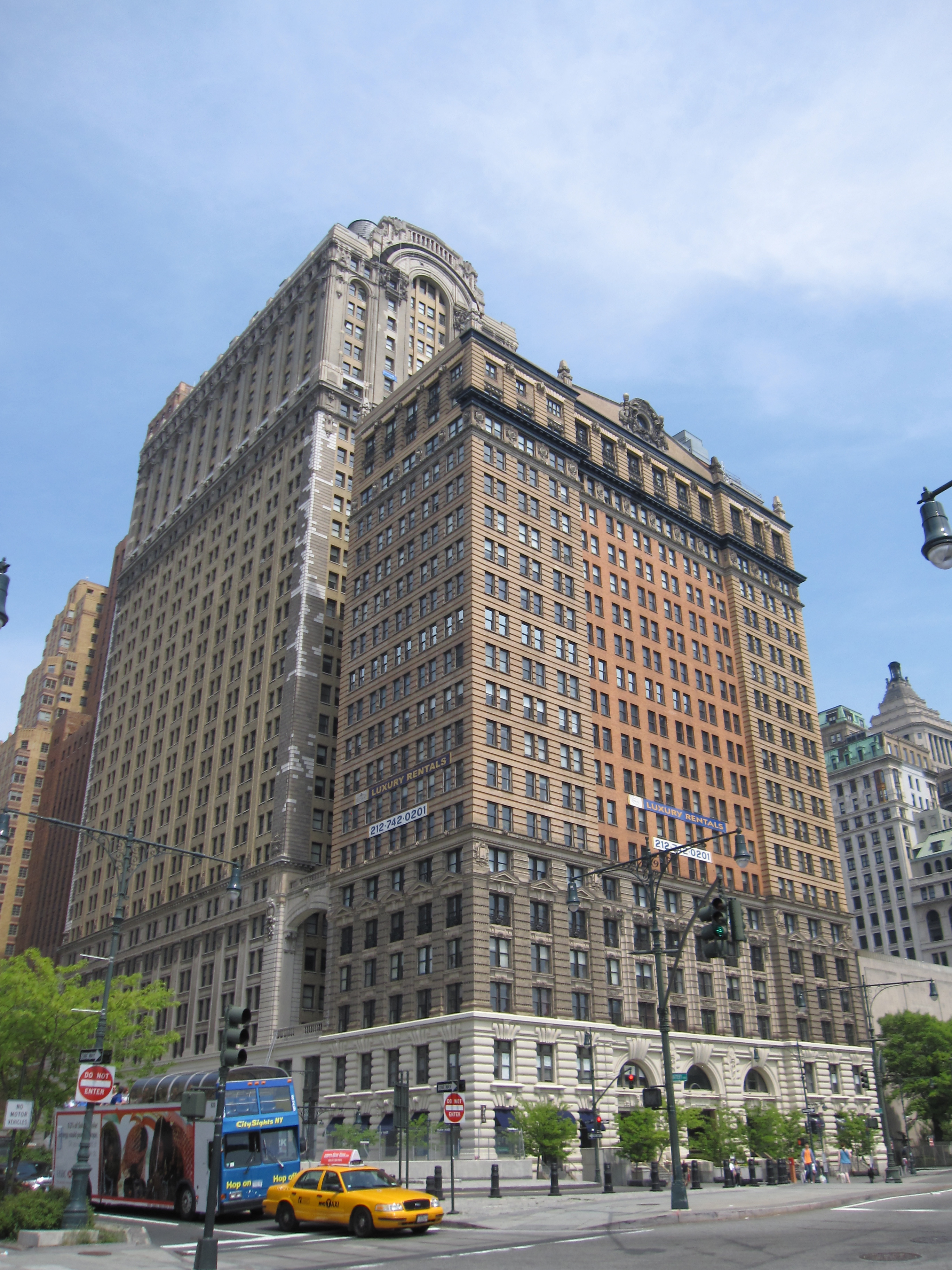
The Whitehall Building was among the earliest skyscrapers built specifically for residential use. Developed by the Whitehall Construction Company, it stood near the Battery, offering luxury apartments with views of the harbor — a radical concept at the time.
Its Beaux-Arts façade lent familiarity to a novel idea: vertical living. The Whitehall Building foreshadowed New York’s eventual embrace of high-rise residential towers, decades before they became commonplace.
5. Metropolitan Life Tower (1909)


Inspired by St. Mark’s Campanile in Venice, the Metropolitan Life Tower translated European historicism into American corporate symbolism. Designed by Napoleon LeBrun & Sons for Metropolitan Life Insurance Company, it became the tallest building in the world upon completion.
The tower expressed stability, permanence, and trust — critical qualities for an insurance firm. Its clock faces and commanding presence turned corporate architecture into a form of branding long before the term existed.
6. Woolworth Building (1913)


The Woolworth Building remains one of the most celebrated skyscrapers ever built. Designed by Cass Gilbert and funded entirely in cash by F. W. Woolworth, it fused Gothic cathedral imagery with modern steel-frame construction.
Nicknamed the “Cathedral of Commerce,” the building treated capitalism with religious reverence. Gargoyles caricatured businessmen, while soaring arches framed corporate ambition as a moral triumph. It redefined what a skyscraper could represent.
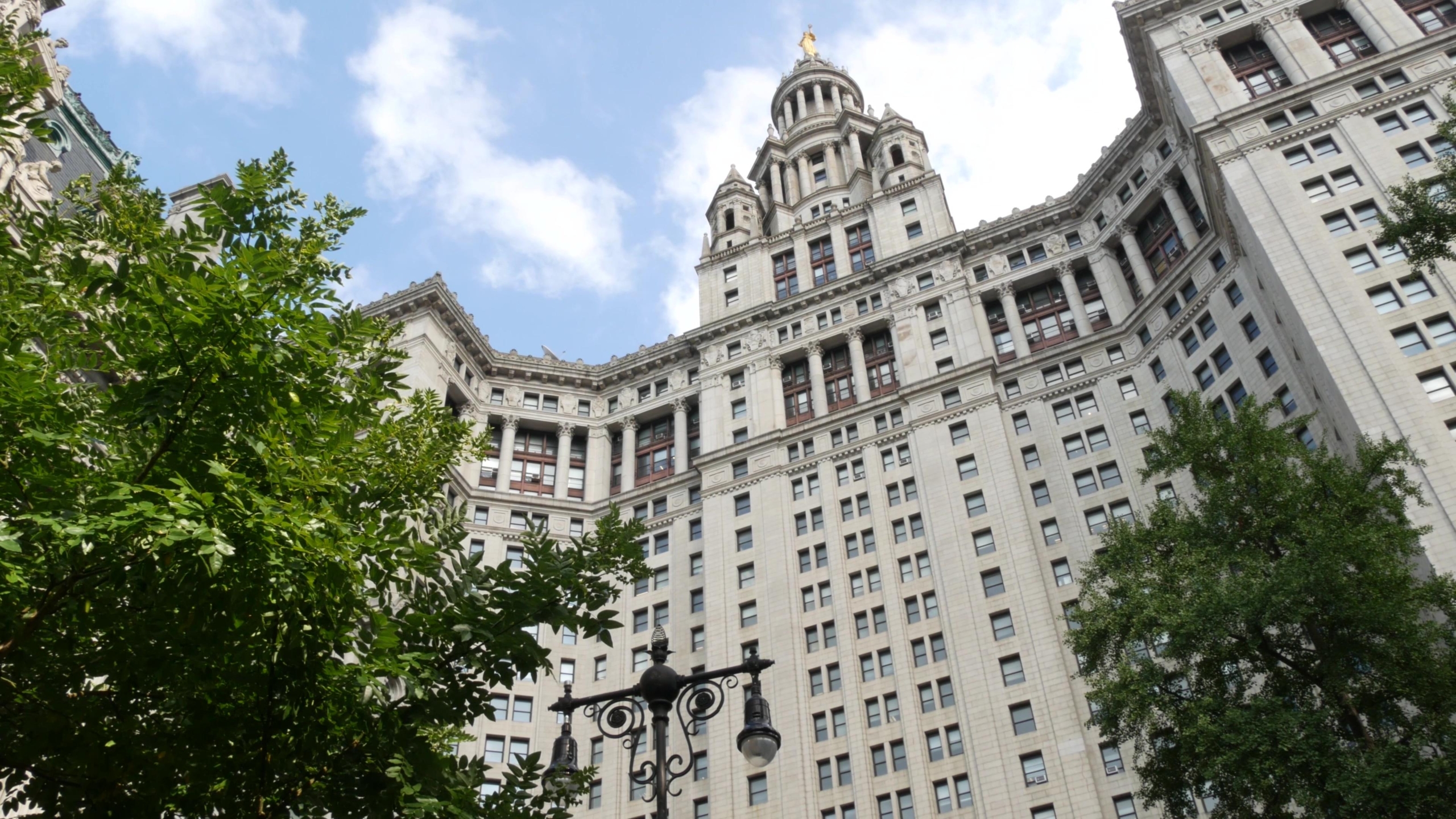
7. Manhattan Municipal Building (1914)


Designed by McKim, Mead & White, the Manhattan Municipal Building proved that skyscrapers were not solely the domain of private capital. Built for the City of New York, it centralized municipal offices in a single monumental structure.
Beaux-Arts in style and civic in spirit, the building bridged boroughs and functions, asserting that government could operate at the same scale as Wall Street — and sometimes larger.
8. Fred F. French Building (1927)

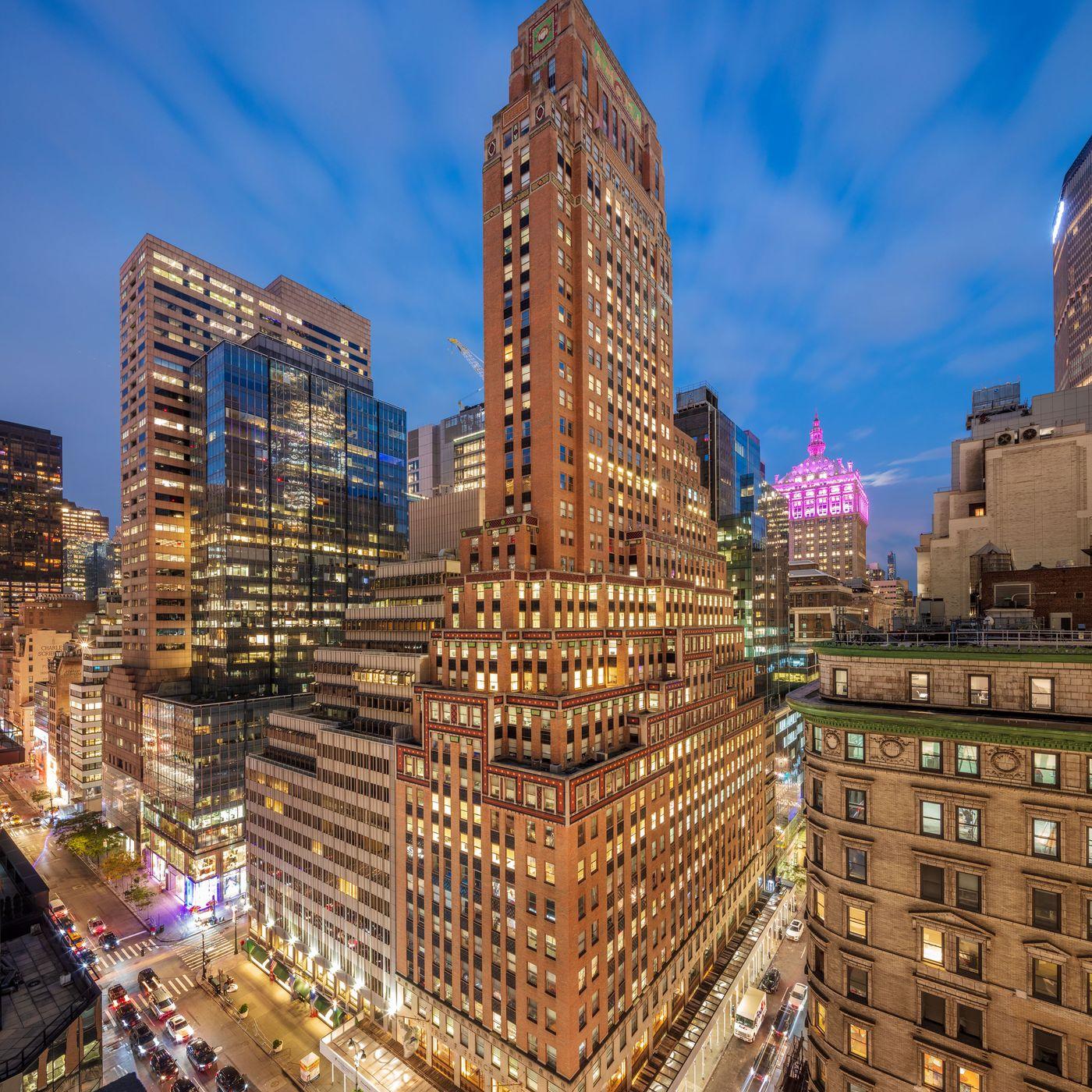
Developed by Fred F. French Companies and designed by H. Douglas Ives, this Neo-Gothic tower rose as part of Midtown’s eastward expansion. Its dark masonry and vertical emphasis reflected the lingering influence of Gothic romanticism.
The building represents speculative optimism — a belief that Midtown would soon eclipse downtown as the city’s commercial heart. History proved that belief correct.
9. New York Life Building (1928)


Cass Gilbert returned to Gothic form for the New York Life Building, crowned with a luminous gilded pyramidal roof. Built for New York Life Insurance Company, the building emphasized trust, tradition, and permanence.
Its ornamental restraint and iconic roofline made it one of Midtown’s most dignified corporate towers, bridging pre-war romanticism and the coming Art Deco era.
10. Chanin Building (1929)


Designed by Sloan & Robertson for the Chanin Construction Company, the Chanin Building stands as one of Art Deco’s most refined expressions. Its terra-cotta ornamentation, bronze detailing, and vertical rhythm celebrated craftsmanship at every scale.
Completed on the eve of the Great Depression, it captured the optimism of the late 1920s — a final flourish before economic reality reshaped the skyline.
Next up:
Part II — Art Deco Ascendant (1930–1933)
Chrysler Building, Empire State, 40 Wall Street, Rockefeller Center, and more.
When you’re ready, say “Continue Part II” and I’ll keep building the skyline.
Love it — let’s keep the skyline rising.
Here’s Part II: Art Deco Ascendant (1930–1933), when New York turned competition, speed, and optimism into architecture at full throttle.
New York’s Skyscrapers: A Vertical History
Part II — Art Deco Ascendant (1930–1933)
11. 40 Wall Street (1930)
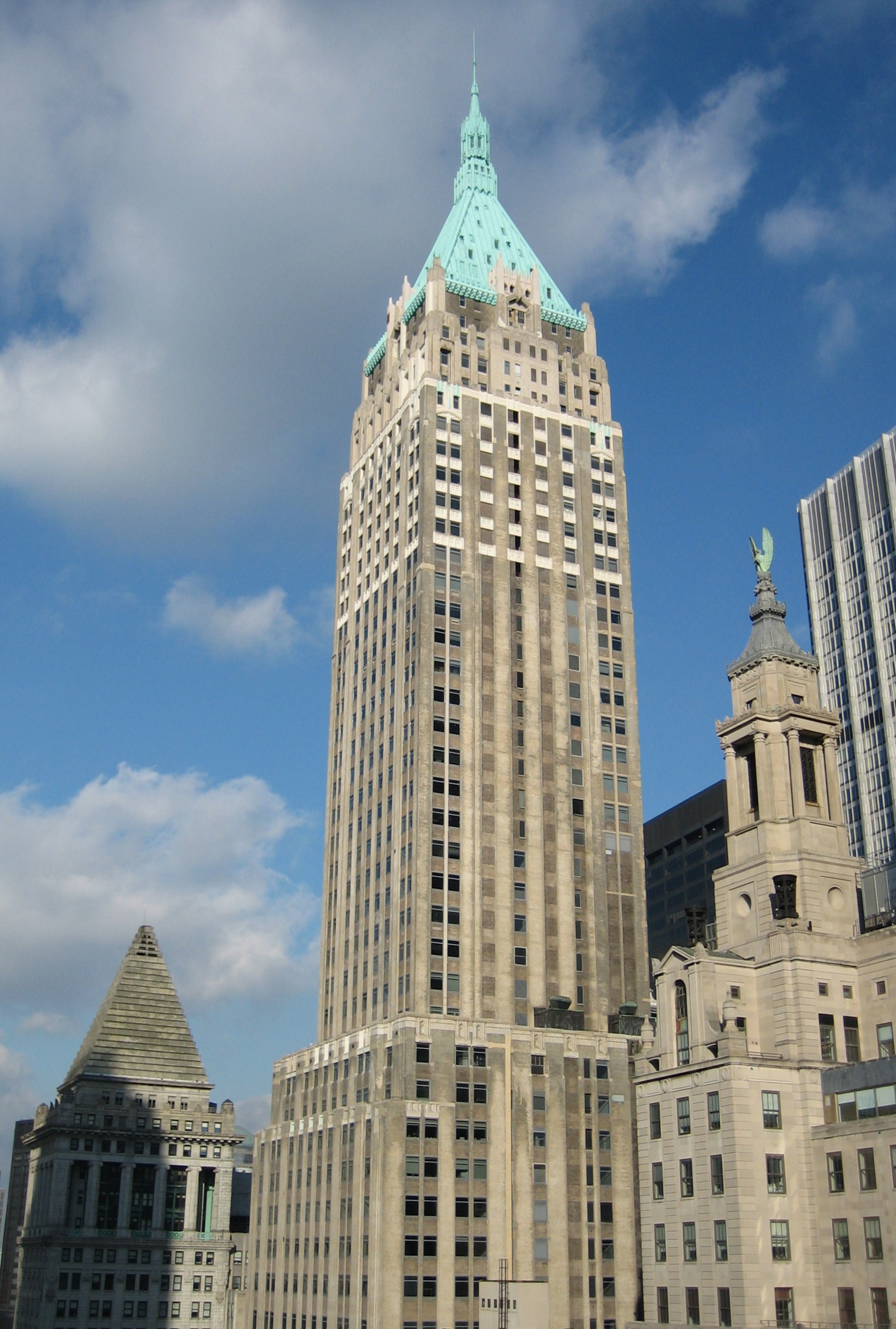
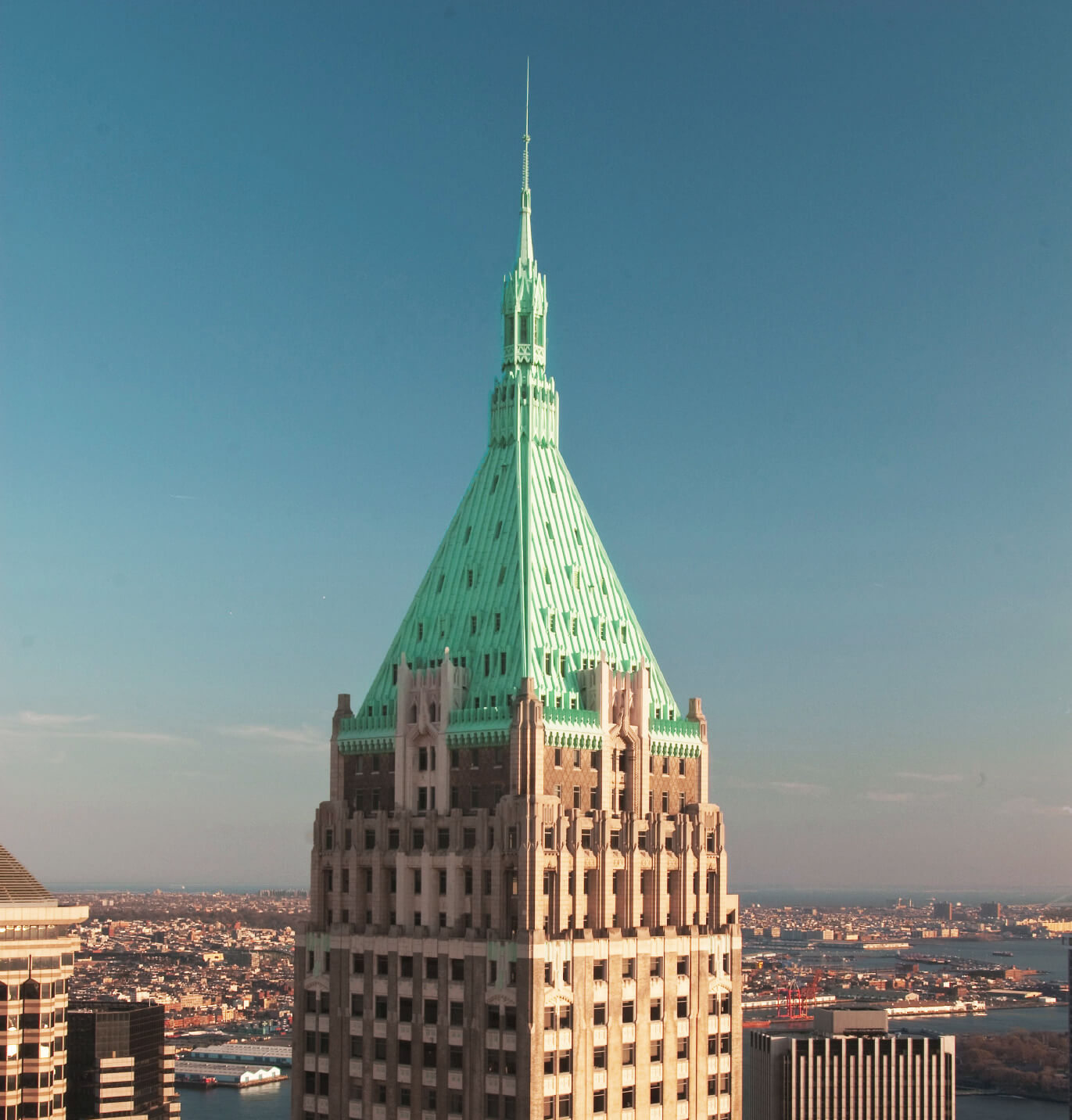
Designed by H. Craig Severance for the Bank of Manhattan Trust Company, 40 Wall Street was conceived as a direct challenge to rival skyscrapers rising across the city. For a brief moment, it claimed the title of the world’s tallest building—an achievement celebrated and eclipsed almost immediately.
Its Art Deco design emphasized speed and vertical thrust, with a slender spire that symbolized financial power during the late 1920s banking boom. The building captures the intensity of corporate rivalry that defined Manhattan on the eve of the Depression.
12. Chrysler Building (1930)


William Van Alen’s Chrysler Building, commissioned by automobile magnate Walter P. Chrysler, remains the most celebrated Art Deco skyscraper in the world. Its stainless-steel crown, sunbursts, and automotive gargoyles transformed industrial motifs into architectural ornament.
Built secretly to surpass 40 Wall Street in height, the Chrysler Building turned the skyscraper race into architectural theater. More than a corporate headquarters, it became a permanent emblem of New York’s glamour, confidence, and design ambition.
13. Daily News Building (1930)


Designed by Raymond Hood for the Daily News Corporation, this building introduced a bolder, more functional interpretation of Art Deco. Its clean lines and massive scale reflected the power of mass media in shaping public opinion.
Inside, the famous rotating globe in the lobby symbolized global reach and immediacy. The Daily News Building marked a shift toward skyscrapers as instruments of information, not just finance.
14. Empire State Building (1931)


Designed by Shreve, Lamb & Harmon and developed by Empire State Inc., the Empire State Building was constructed in just over a year—an unmatched feat of speed and coordination. Rising 102 stories, it instantly became the tallest building in the world.
Its Art Deco styling is restrained but powerful, emphasizing mass, symmetry, and scale. Built during the Great Depression, it embodied faith in the future at a time when optimism was in short supply.
15. McGraw-Hill Building (1931)


Raymond Hood designed the McGraw-Hill Building as part of Rockefeller Center, blending Art Deco ornament with emerging modernist principles. Its green terra-cotta façade distinguished it from its limestone neighbors.
The building represents a transition moment—where decoration began to give way to clarity, efficiency, and abstraction. It is both Art Deco and a precursor to International Style modernism.
16. One Wall Street (1931)

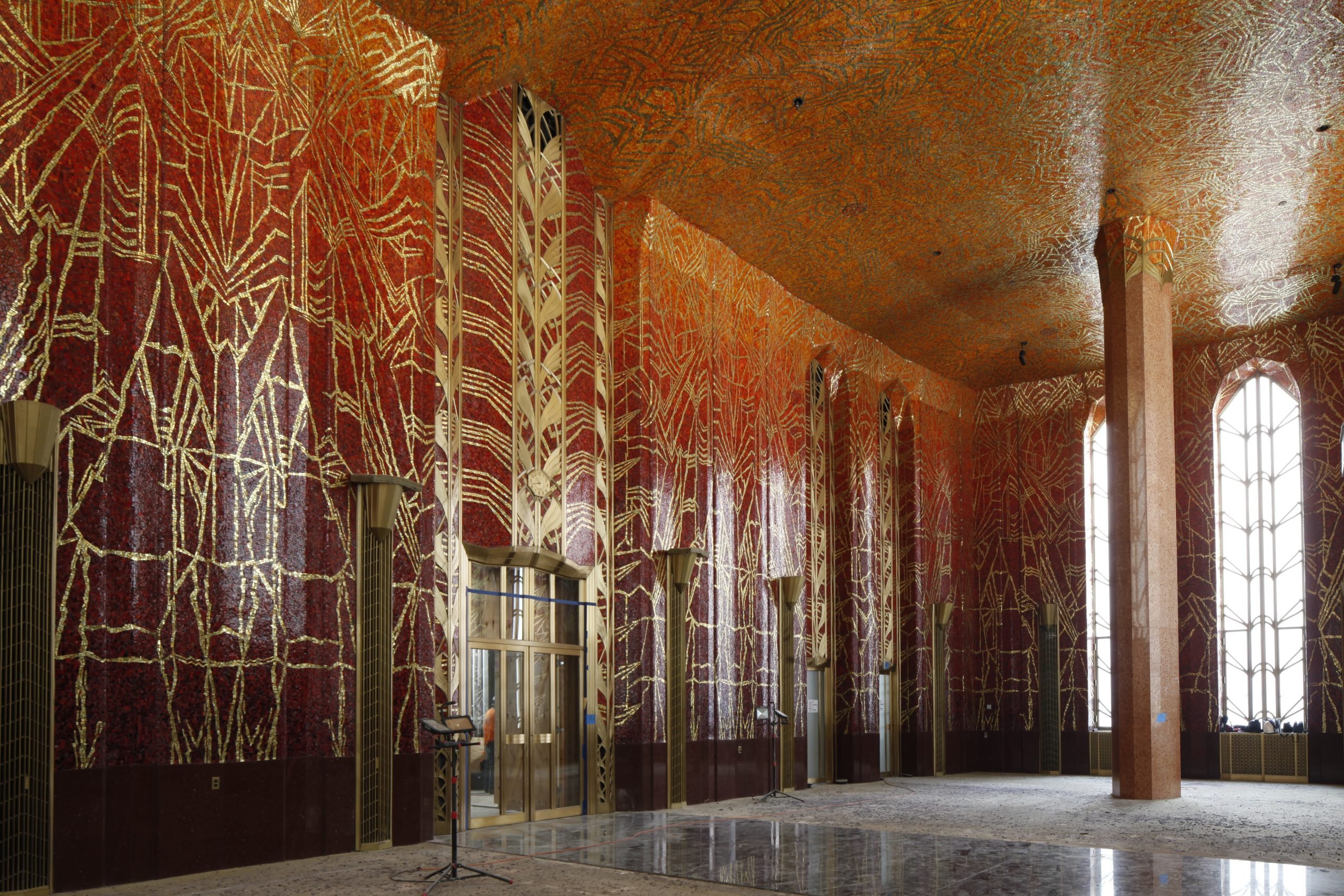
Designed by Voorhees, Gmelin & Walker for Irving Trust Company, One Wall Street brought Art Deco refinement to Lower Manhattan. Its limestone façade conveyed solidity and confidence at a moment of financial uncertainty.
Inside, the famed Red Room showcased mosaic artistry at a level rarely matched in commercial buildings. One Wall Street demonstrated that banks could be both conservative and architecturally adventurous.
17. General Electric Building (1931)
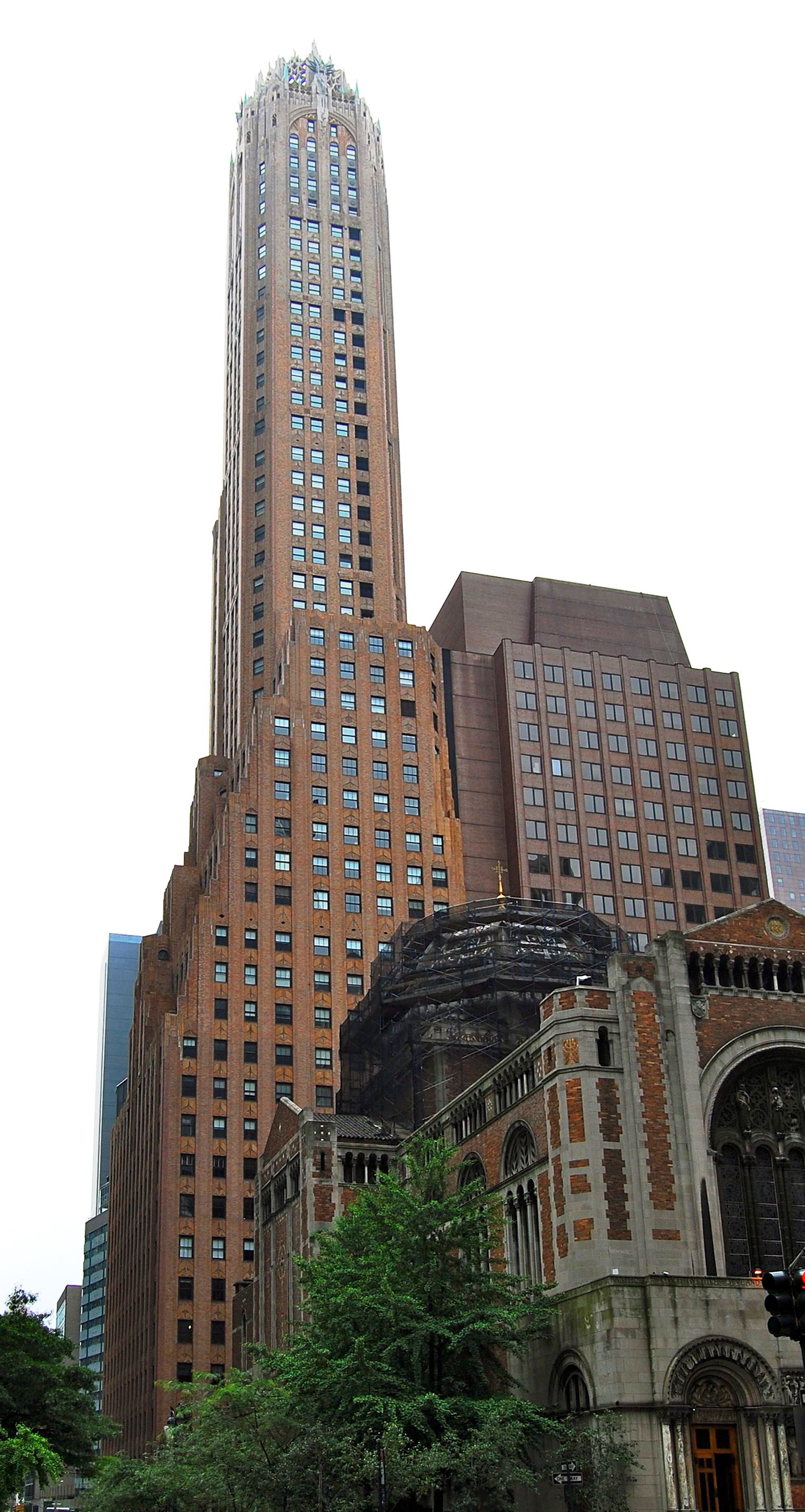
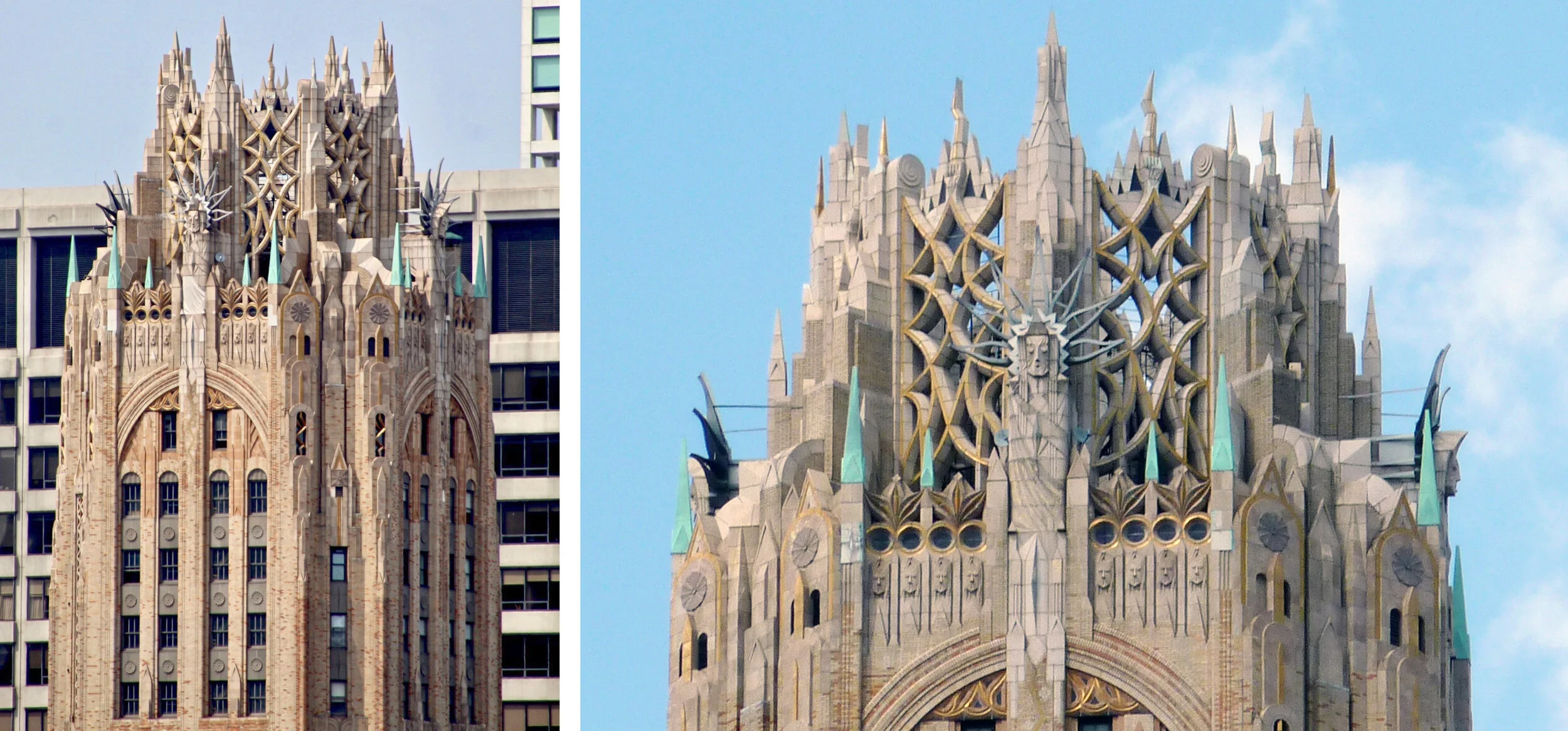
Designed by Cross & Cross for RCA and General Electric, this tower merged Gothic verticality with Art Deco geometry. Its setbacks and ornament symbolized radio waves and broadcast technology.
The building stands as a monument to early mass communication, translating invisible signals into physical form. It remains one of Midtown’s most distinctive silhouettes.
18. 70 Pine Street (1932)


Clinton & Russell designed 70 Pine Street for the Cities Service Company as a dramatic limestone tower rising from the Financial District. Its narrow footprint and soaring crown emphasized vertical elegance.
Often overshadowed by Midtown giants, 70 Pine Street remains one of downtown’s finest Art Deco achievements, combining corporate ambition with architectural drama.
19. 30 Rockefeller Plaza (1933)


The centerpiece of Rockefeller Center, 30 Rockefeller Plaza was designed by Raymond Hood as the anchor of the largest private development in American history. Built during the Depression, it represented confidence on an unprecedented scale.
Its Art Deco reliefs, setbacks, and integration with public plazas redefined how skyscrapers could interact with the city. Rockefeller Center wasn’t just a building—it was a new urban model.
Up next:
Part III — Glass, Steel, and Corporate Modernism (1950s–1970s)
Lever House, Seagram Building, UN Secretariat, Pan Am, and the transformation of Midtown.
When you’re ready, say “Continue Part III.”
Here we go — the skyline pivots hard.
Welcome to Part III: Glass, Steel, and Corporate Modernism (1950s–1970s), when ornament fell away and power learned to speak softly… and very tall.
New York’s Skyscrapers: A Vertical History
Part III — Glass, Steel, and Corporate Modernism
20. United Nations Secretariat Building (1952)


Designed under the direction of Wallace K. Harrison for the United Nations, the Secretariat Building introduced International Style modernism to New York on a monumental scale. Rising as a thin slab along the East River, it rejected historical reference entirely in favor of glass, steel, and clarity.
The building’s neutrality was intentional. It symbolized diplomacy, transparency, and global cooperation, setting a precedent for postwar corporate and institutional skyscrapers worldwide.
21. Lever House (1952)


Designed by Skidmore, Owings & Merrill for Lever Brothers, Lever House changed Park Avenue forever. It was New York’s first true glass curtain-wall skyscraper, replacing masonry mass with lightness and reflection.
Set back above a plaza, the building introduced open space as a corporate amenity. Its elegance and restraint became the template for modern office towers across the city and beyond.
22. Seagram Building (1958)


Commissioned by the Seagram Company and designed by Ludwig Mies van der Rohe with Philip Johnson, the Seagram Building is widely regarded as the finest modernist skyscraper ever built. Its bronze façade, perfect proportions, and disciplined geometry elevated minimalism into luxury.
By sacrificing rentable floor area for a public plaza, Seagram redefined prestige. Power, it suggested, did not need to shout.
23. Time-Life Building (1959)


Built by SOM for Time Inc., the Time-Life Building extended modernism westward from Park Avenue to Sixth Avenue. Its clean façade and modular grid reflected efficiency, clarity, and corporate order.
The building helped transform Sixth Avenue into a corridor of modern towers, reinforcing Midtown’s dominance as the city’s corporate core.
24. 1 Chase Manhattan Plaza (1961)


Designed by SOM for Chase Manhattan Bank, this tower introduced the superblock to Lower Manhattan. The building rose from an open plaza, separating tower from street in a distinctly modernist gesture.
It symbolized the consolidation of financial power and the belief that modern planning could rationalize the city — an idea later reconsidered, but never forgotten.
25. MetLife Building (1963)


Originally built as the Pan Am Building by Emery Roth & Sons, this massive structure sits directly atop Grand Central Terminal. Designed for aviation-era ambition, it prioritized scale and visibility over contextual harmony.
Controversial from the start, it nonetheless defined an era when corporate reach was measured in sheer bulk and dominance over infrastructure.
26. 55 Water Street (1972)
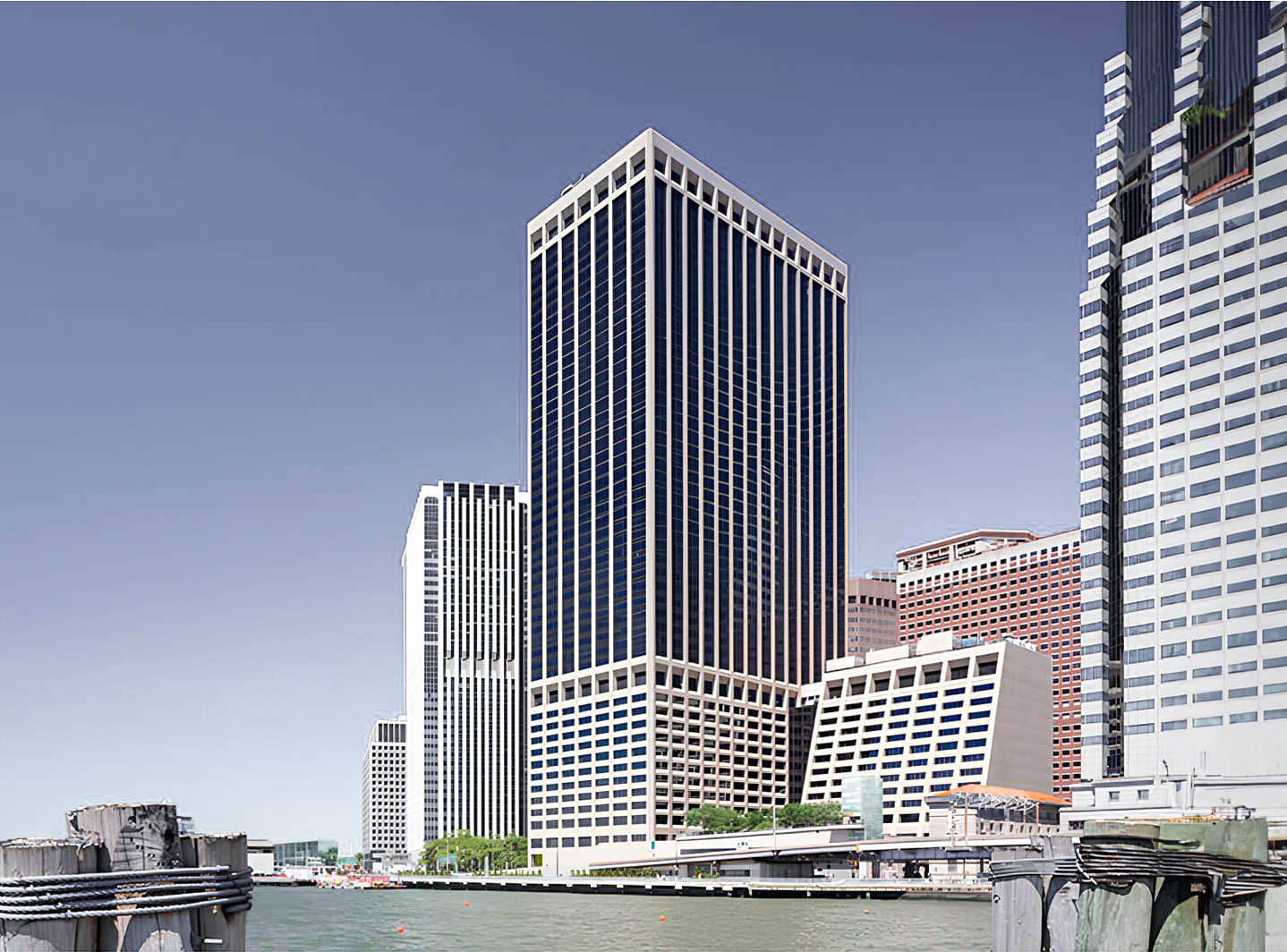
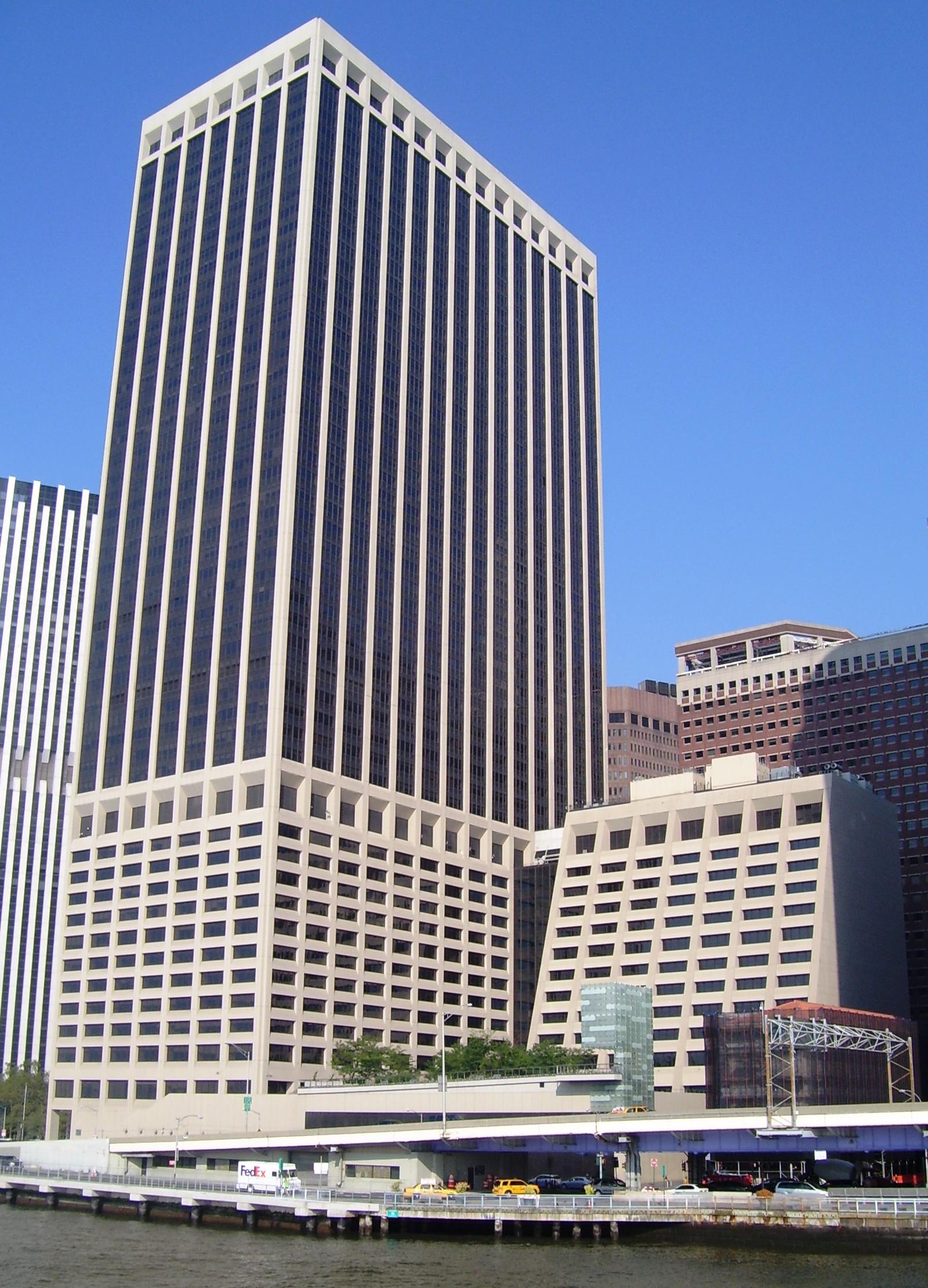
Developed for U.S. Steel and designed by Emery Roth & Sons, 55 Water Street is one of the largest office buildings in the world by floor area. Its fortress-like form reflects late modernism’s emphasis on efficiency and scale.
The building marked a moment when quantity rivaled elegance — and when downtown prioritized corporate density over architectural delicacy.
27. Citigroup Center (1977)
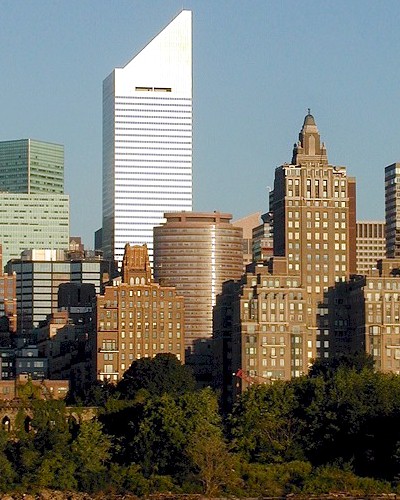

Designed by Hugh Stubbins for Citicorp, this tower broke modernist orthodoxy with its sloped roof and elevated base. Engineering innovations allowed it to cantilever above a church, preserving the site below.
The building signaled that modernism was loosening — willing to bend rules, visually and structurally, to adapt to urban complexity.
What Part III Represents
This era replaced ornament with corporate identity, masonry with glass, and symbolism with precision. These buildings reflect a New York that saw itself as a global headquarters — rational, efficient, and confident enough to be understated.
Up next:
Part IV — Postmodernism, Branding, and the Return of Symbolism (1980s–1990s)
Trump Tower, 550 Madison Avenue, and the rebellion against pure modernism.
Say “Continue Part IV” when you’re ready.
Let’s do it.
The skyline swings back toward identity, symbolism, and spectacle in Part IV, when architects rejected glass-box purity and brought storytelling back into the vertical city.
New York’s Skyscrapers: A Vertical History
Part IV — Postmodernism, Branding, and the Return of Symbolism (1980s–1990s)
28. Trump Tower (1983)


Designed by Der Scutt for the Trump Organization, Trump Tower marked a decisive shift in New York skyscraper culture. Instead of understated corporate restraint, the building embraced luxury, visibility, and brand-forward architecture. Its reflective bronze façade distinguished it from the black-and-silver modernist towers nearby.
Inside, the multi-story atrium with escalators, marble, and retail transformed the skyscraper into a public performance space. Trump Tower merged residential, commercial, and retail uses into a single vertical luxury ecosystem—an idea that would later define 21st-century high-rise development.
29. 550 Madison Avenue (1984)


Philip Johnson and John Burgee’s design for AT&T openly rejected modernist minimalism. Its famous “Chippendale” pediment reintroduced historical reference, irony, and symbolism into the skyline—provoking intense debate within the architectural community.
The building declared that skyscrapers could once again communicate personality and corporate culture. Love it or hate it, 550 Madison Avenue legitimized postmodernism and ended the dominance of the anonymous glass box.
30. MetLife Building (Recontextualized, 1990s Legacy)


Though completed earlier, the Pan Am—later MetLife—Building’s cultural influence peaked in the postmodern era. Its sheer mass and logo-driven identity became emblematic of late 20th-century corporate dominance.
By the 1980s and 1990s, it was no longer just a building but a symbol of corporate power occupying civic space—foreshadowing debates about branding, scale, and urban responsibility that still shape development today.
31. Citigroup Center (Postmodern Engineering Legacy)

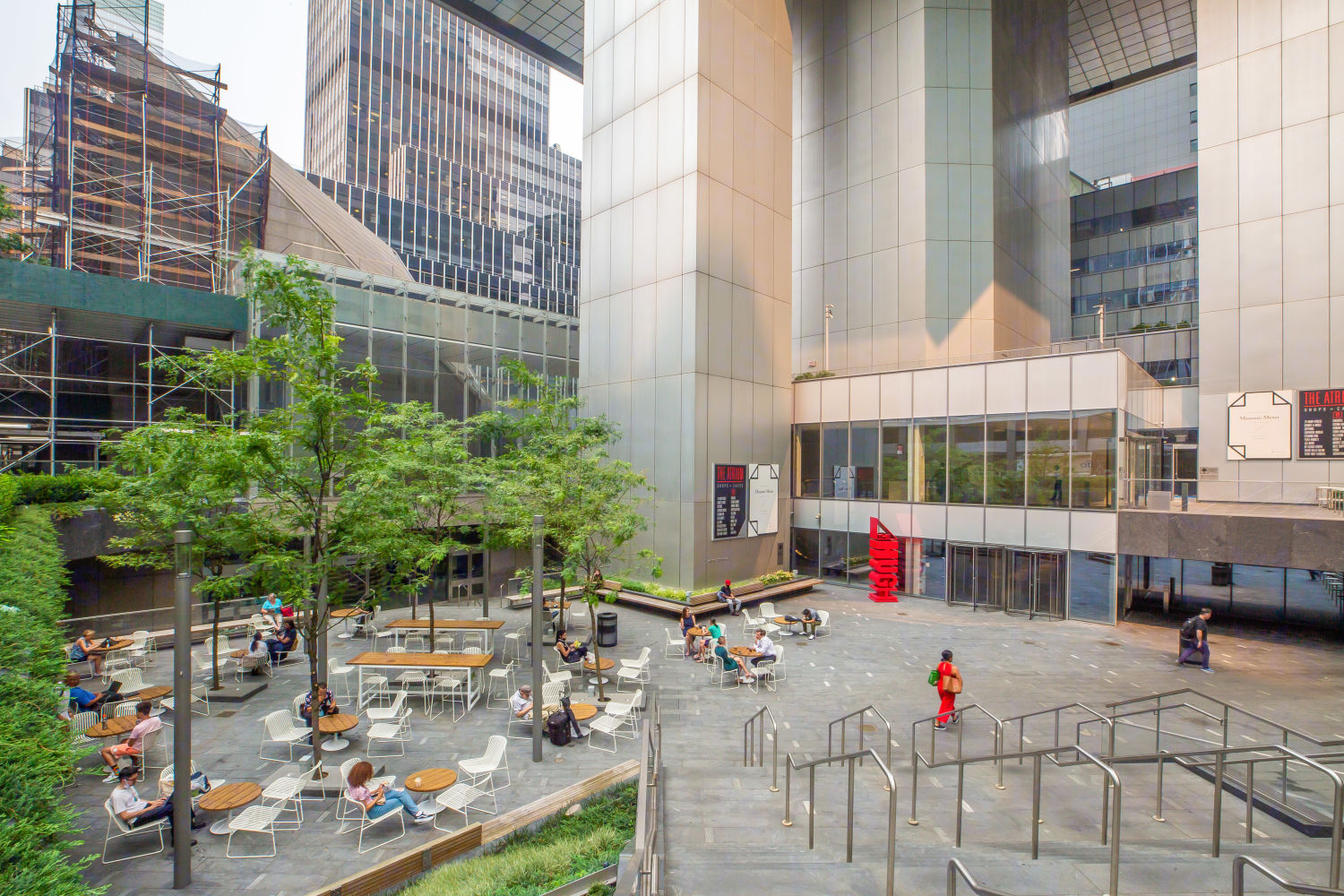
While designed in the modernist era, Citigroup Center’s unconventional form—sloped roof, stilted base, and engineering audacity—anticipated postmodern freedom. Its very existence challenged the idea that skyscrapers must follow strict formal rules.
The building’s later structural retrofit, quietly executed in the 1990s, became a legendary case study in engineering ethics, reinforcing that postmodern complexity required new forms of responsibility.
32. World Trade Center Twin Towers (Cultural Legacy)


Although completed in the early 1970s, the Twin Towers’ symbolic meaning crystallized during the 1980s and 1990s. Designed by Minoru Yamasaki for the Port Authority, they represented global commerce at a planetary scale.
By the end of the century, the towers had become emotional landmarks—less about architecture and more about identity. Their loss would fundamentally reshape New York’s skyline and architectural priorities.
What Part IV Represents
This era restored meaning and personality to skyscrapers. Buildings became symbols again—of wealth, media, corporations, and cultural debate. Architecture was no longer neutral. It spoke loudly, sometimes controversially, about who owned the city and why.
Up next:
Part V — Resilience, Sustainability, and the Supertall Era (2000s–Present)
Hearst Tower, One World Trade Center, Billionaires’ Row, Hudson Yards, and the future skyline.
When you’re ready, say “Continue Part V.”
Let’s bring it home.
This is the skyline after crisis, after carbon, after height limits stopped mattering—Part V: Resilience, Sustainability, and the Supertall Era (2000s–Present).
New York’s Skyscrapers: A Vertical History
Part V — Resilience, Sustainability, and the Supertall Era
33. Hearst Tower (2006)


Designed by Foster + Partners for the Hearst Corporation, Hearst Tower rises from a preserved 1928 base, symbolizing continuity rather than erasure. Its steel diagrid structure reduced material use while creating a striking geometric form.
The tower became a model for sustainable skyscraper design, proving that environmental responsibility and corporate prestige could coexist in Midtown Manhattan.
34. 7 World Trade Center (2006)


Designed by SOM and developed by Silverstein Properties, 7 World Trade Center was the first major tower completed after 9/11. Its reflective façade and carefully proportioned form emphasized dignity rather than spectacle.
The building set the architectural tone for the rebuilding of Lower Manhattan—quiet, precise, and forward-looking.
35. New York Times Building (2007)

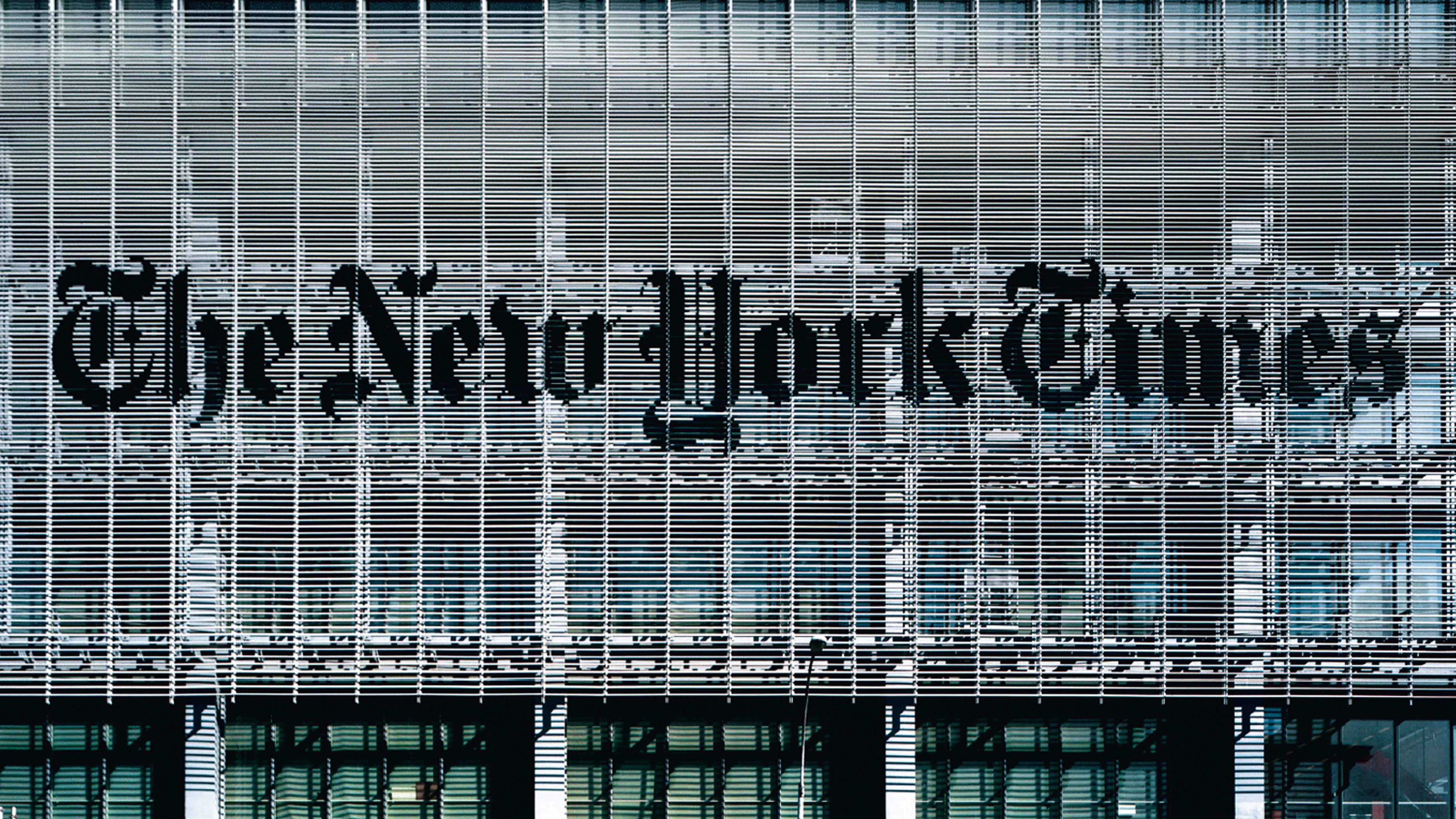
Renzo Piano designed the New York Times Building as a civic object as much as a corporate headquarters. A ceramic rod screen filters light and softens the tower’s presence along Eighth Avenue.
Transparency—both literal and metaphorical—became the building’s defining theme, aligning architecture with journalistic values.
36. Bank of America Tower (2009)


Designed by CookFox with SOM, One Bryant Park raised the bar for green skyscrapers in New York. Built for Bank of America, it incorporated on-site power generation, water recycling, and advanced air filtration.
The tower reframed sustainability as corporate infrastructure—not an aesthetic choice, but an operational one.
37. 4 World Trade Center (2013)

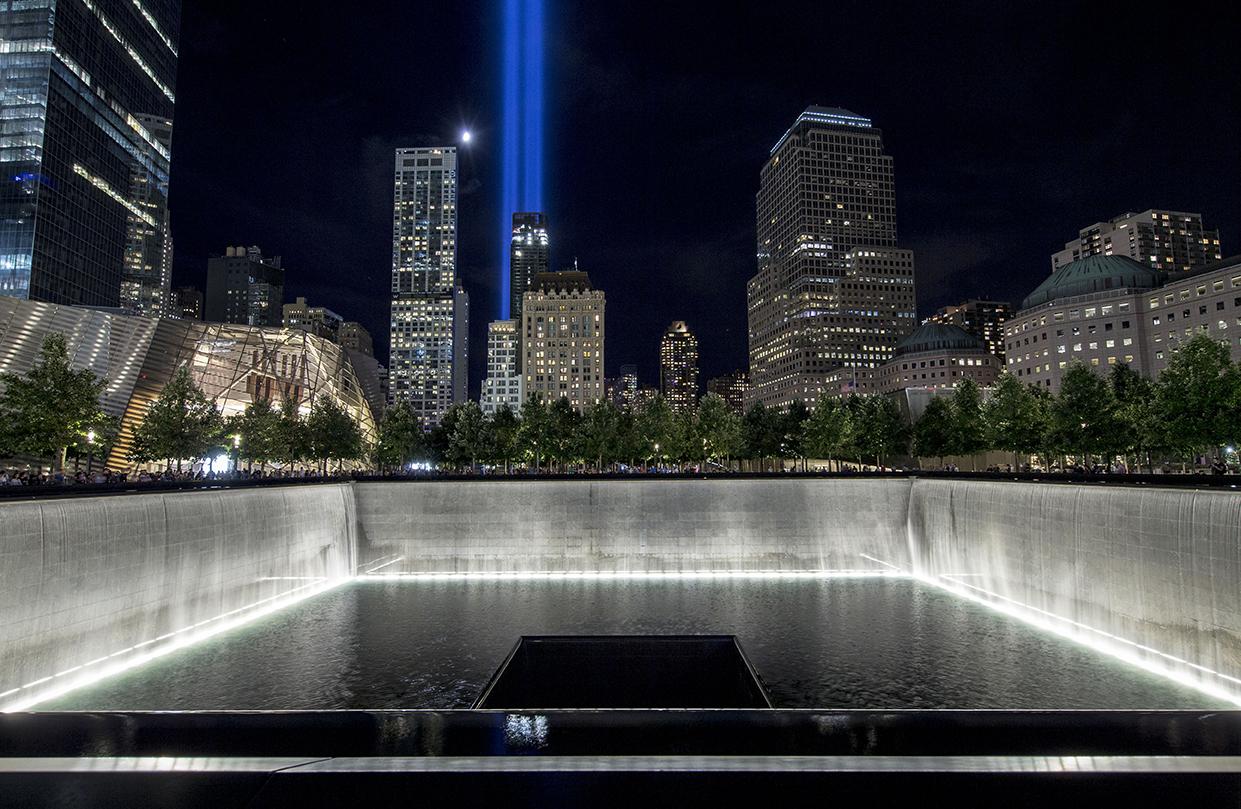
Designed by Fumihiko Maki, 4 World Trade Center is deliberately restrained. Its reflective glass dissolves into the sky, minimizing visual weight near the memorial.
The building demonstrates architectural humility—proof that absence and reflection can be as powerful as height.
38. One World Trade Center (2014)


Designed by SOM and owned by the Port Authority of New York and New Jersey, One World Trade Center is both skyscraper and symbol. Its height—1,776 feet—anchors it firmly in national narrative.
Architecturally restrained but emotionally charged, the tower represents resilience, memory, and renewal on a monumental scale.
39. One57 (2014)


Designed by Christian de Portzamparc for Extell Development, One57 launched the supertall residential era along Central Park South. Its faceted blue-glass façade introduced sculptural luxury to the skyline.
The building redefined Manhattan’s relationship with wealth, height, and residential prestige.
40. 432 Park Avenue (2015)


Rafael Viñoly’s 432 Park Avenue reduced the skyscraper to its purest form: a square grid extruded skyward. Developed by CIM Group, it rejected ornament entirely.
Its stark presence divided public opinion—but permanently altered New York’s skyline geometry.
41. 30 Hudson Yards (2019)


Designed by Kohn Pedersen Fox for Related Companies, 30 Hudson Yards anchors Manhattan’s largest private real estate development. The tower combines corporate offices with the dramatic Edge observation deck.
It signals a westward shift in Manhattan’s center of gravity.
42. 53W53 (2019)


Jean Nouvel’s 53W53 rises like a crystalline shard beside the Museum of Modern Art. Developed by Hines, it fuses residential luxury with architectural experimentation.
Its expressive form challenges the monotony of the supertall typology.
43. One Vanderbilt (2020)


Designed by Kohn Pedersen Fox for SL Green, One Vanderbilt leveraged zoning bonuses to fund transit improvements at Grand Central. The result is a supertall deeply integrated with infrastructure.
It represents a new development model—density in exchange for public benefit.
44. Central Park Tower (2020)


Designed by Adrian Smith + Gordon Gill for Extell Development, Central Park Tower is the tallest residential building in the world. Its height asserts dominance over the city’s most valuable real estate—Central Park views.
It marks the peak of the luxury vertical arms race.
45. The Spiral (2023)

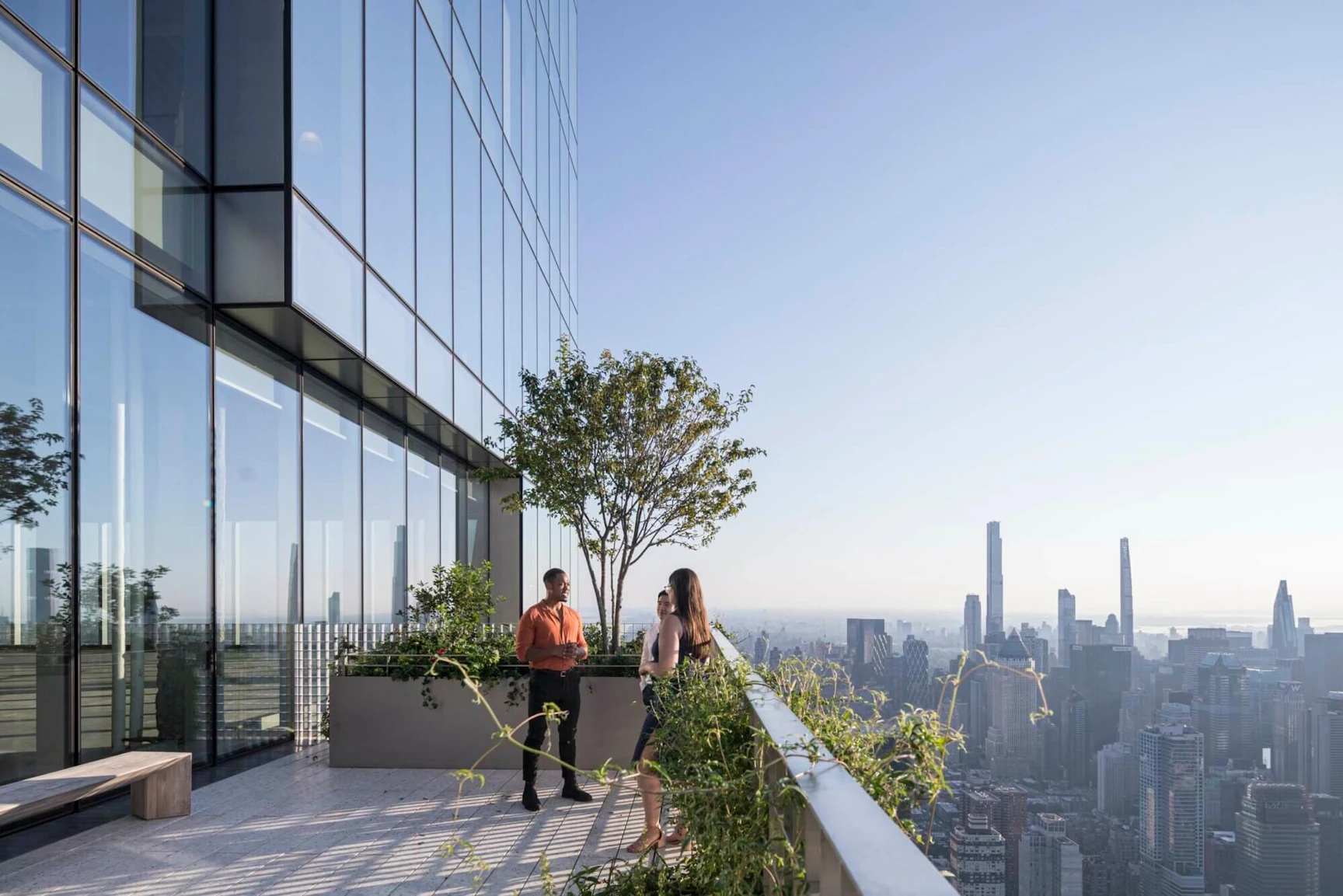
Bjarke Ingels Group designed The Spiral for Tishman Speyer as a biophilic response to the glass tower. Cascading terraces wrap the building in greenery, reintroducing nature into the vertical city.
The Spiral suggests where skyscrapers may be headed next—taller, greener, and more humane.
Final Thought: The Skyline as Biography
Taken together, these buildings form a biography of New York itself—ambitious, conflicted, innovative, and never finished. From steel-frame pioneers to needle-thin supertalls, the skyline is not a backdrop. It is the city’s most honest autobiography.
